|
Analog Electronics: Basic Circuits of Operational Amplifiers
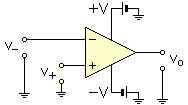
Theory Operational Amplifiers Operational Amplifiers (OAs) are highly stable, high gain dc difference amplifiers. Since there is no capacitive coupling between their various amplifying stages, they can handle signals from zero frequency (dc signals) up to a few hundred kHz. Their name is derived by the fact that they are used for performing mathematical operations on their input signal(s). Figure 1 shows the symbol for an OA. There are two inputs, the inverting input (-) and the non-inverting input (+). These symbols have nothing to do with the polarity of the applied input signals.
Figure 1. Symbol of the operational amplifier. Connections to power supplies are also shown.
The output signal (voltage), vo, is given by: vo = A(v+ − v−) v+ and v− are the signals applied to the non-inverting and to the inverting input, respectively. Α represents the open loop gain of the OA. A is infinite for the ideal amplifier, whereas for the various types of real OAs, it is usually within the range of 104 to 106 OAs require two power supplies to operate, supplying a positive voltage (+V) and a negative voltage (−V) with respect to circuit common. This bipolar power supply allows OAs to generate output signals (results) of either polarity. The output signal (vo) range is not unlimited. The voltages of the power supplies determine its actual range. Thus, a typical OA fed with −15 and +15 V, may yield a vo within the (approximately) −13 to +13 V range, called operational range. Any result expected to be outside this range is clipped to the respective limit, and OA is in a saturation stage. The connections to the power supplies and to the circuit common symbols, shown in Figure 1, hereafter will be implied, and they will be not shown in the rest of the circuits for simplicity. Because of their very high open loop gain, OAs are almost exclusively used with some additional circuitry (mostly with resistors and capacitors), required to ensure a negative feedback loop. Through this loop a tiny fraction of the output signal is fed back to the inverting input. The negative feedback stabilizes the output within the operational range and provides a much smaller but precisely controlled gain, the so-called closed loop gain. Circuits of OAs have been used in the past as analog computers, and they are still in use for mathematical operations and modification of the input signals in real time. A large variety of OAs is commercially available in the form of low cost integrated circuits. There is a plethora of circuits with OAs performing various mathematical operations. Each circuit is characterized by its own transfer function, i.e. the mathematical equation describing the output signal (vo) as a function of the input signal (vi) or signals (v1, v2, ..., vn). Generally, transfer functions can be derived by applying Kirchhoff's rules and the following two simplifying assumptions: #1. The output signal (vo) acquires a value that (through the feedback circuits) practically equates the voltages applied to both inputs, i.e. v+ ≈ v−. #2. The input resistance of both OA inputs is extremely high(usually within the range 106-1012 MΩ, for the ideal OA this is infinite), thus no current flows into them.
Inverting Amplifier The basic circuit of the inverting amplifier is shown in Figure 2.
Figure 2. Inverting amplifier.
The transfer function is derived as follows: Considering the arbitrary current directions we have: i1 = (vi − vs)/Ri and i2 = (vs − vo)/Rf The non-inverting input is connected directly to the circuit common (i.e. v+ = 0 V), therefore (considering simplifying assumption #1) vs = v− = 0 V, therefore: i1 = vi/Ri and i2 = − vo/Rf Since there is no current flow to any input (simplifying assumption #2), it is i1 = i2 Therefore, the transfer function of the inverting amplifier is vo = −(Rf/Ri)vi Thus, the closed loop gain of the inverting amplifier is equal to the ratio of Rf (feedback resistor) over Ri (input resistor). This transfer function describes accurately the output signal as long as the closed loop gain is much smaller than the open loop gain A of the OA used (e.g. it must not exceed 1000), and the expected values of vo are within the operational range of the OA. Summing AmplifierThe summing amplifier is a logical extension of the previously described circuit, with two or more inputs. Its circuit is shown in Figure 3.
Figure 3. Summing amplifier.
The transfer function of the summing amplifier (similarly derived) is: vo = −(v1/R1 + v2/R2 + ... + vn/Rn)Rf Thus if all input resistors are equal, the output is a scaled sum of all inputs, whereas, if they are different, the output is a weighted linear sum of all inputs. The summing amplifier is used for combining several signals. The most common use of a summing amplifier with two inputs is the amplification of a signal combined with a subtraction of a constant amount from it (dc offset). Difference amplifierDifference amplifier precisely amplifies the difference of two input signals. Its typical circuit is shown in Figure 4. |